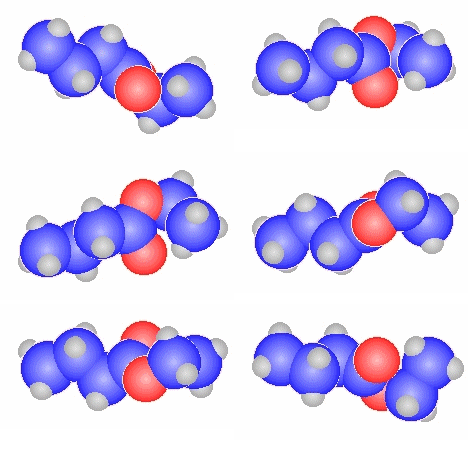
In the second step of the reaction an ammonia molecule may remove one of the hydrogens on the -NH3+. An ammonium ion is formed, together with a primary amine - in this case, ethylamine.

This reaction is, however, reversible. Your product will therefore contain a mixture of ethylammonium ions, ammonia, ethylamine and ammonium ions. Your major product will only be ethylamine if the ammonia is present in very large excess.
Unfortunately the reaction doesn't stop here. Ethylamine is a good nucleophile, and goes on to attack unused bromoethane. This gets so complicated that it is dealt with on a separate page. You will find a link at the bottom of this page.
The reaction of tertiary halogenoalkanes with ammonia
The facts
The facts of the reactions are exactly the same as with primary halogenoalkanes. The halogenoalkane is heated in a sealed tube with a solution of ammonia in ethanol.
For example:


Followed by:

The mechanism
This mechanism involves an initial ionisation of the halogenoalkane:

followed by a very rapid attack by the ammonia on the carbocation (carbonium ion) formed:

This is again an example ofnucleophilic substitution.
This time the slow step of the reaction only involves one species - the halogenoalkane. It is known as an SN1 reaction.
There is a second stage exactly as with primary halogenoalkanes. An ammonia molecule removes a hydrogen ion from the -NH3+ group in a reversible reaction. An ammonium ion is formed, together with an amine.

The reaction of secondary halogenoalkanes with ammonia
It is very unlikely that any of the current UK-based syllabuses for 16 - 18 year olds will ask you about this. In the extremely unlikely event that you will ever need it, secondary halogenoalkanes use both an SN2 mechanism and an SN1.
Make sure you understand what happens with primary and tertiary halogenoalkanes, and then adapt it for secondary ones should ever need to.